
The Top 10 Glacier Ice Caves in the World
Sapphire ceilings, tunnels carved by fire and caves that vanish with the melt — ten frozen palaces to see while they are still there.
On this page
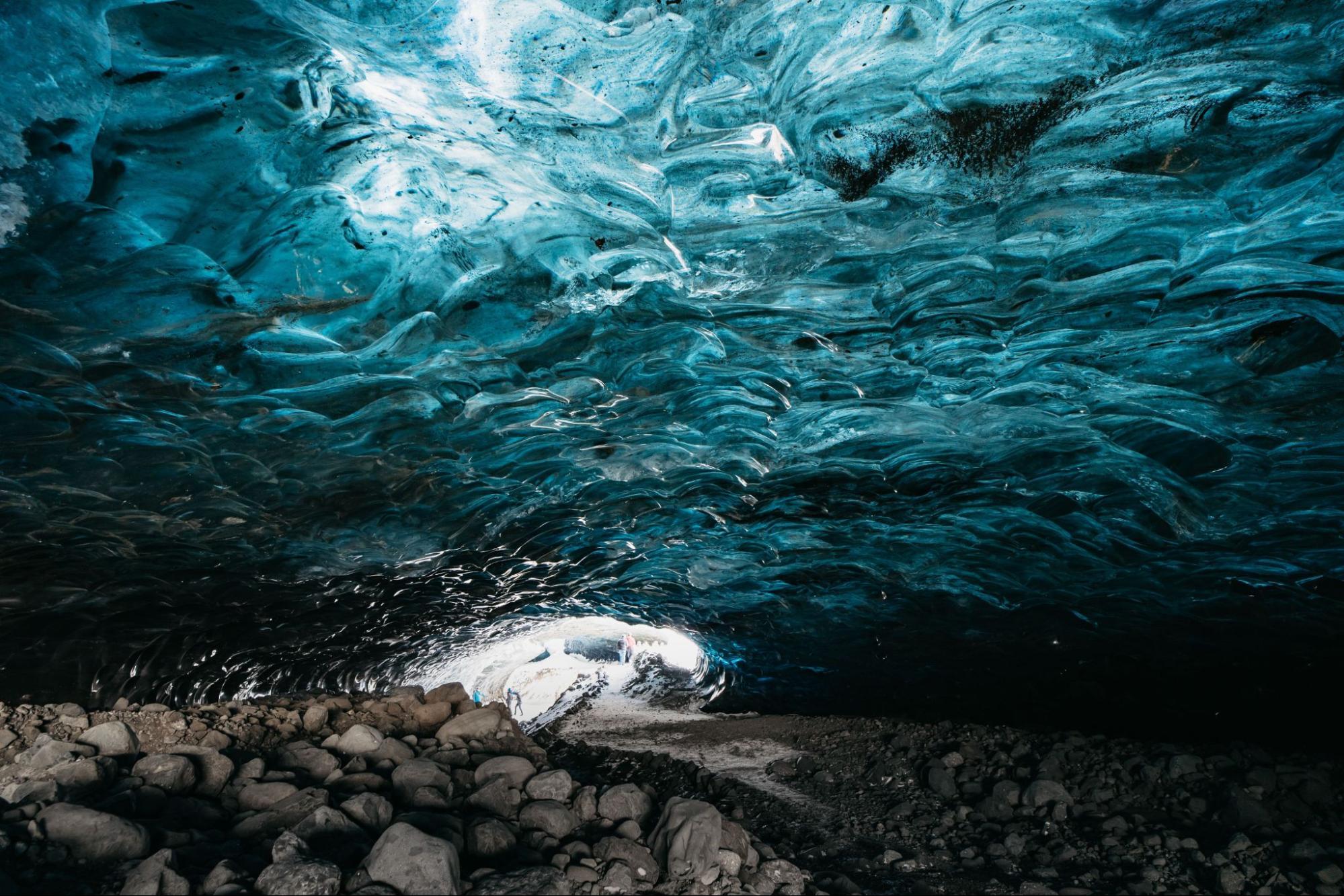
Stepping inside a glacier ice cave feels like leaving Earth for a frozen, alien world. Geothermal heat, active volcanoes and summer meltwater carve tunnels beneath enormous sheets of ice, and the light that filters through them turns deep sapphire, electric blue and sometimes green.
Because glaciers are always moving and changing, every ice cave is a temporary masterpiece with an expiry date. If you want to see these frozen palaces before they melt away, here are the ten best glacier ice caves in the world.
1. Vatnajökull Glacier Ice Caves (Skaftafell, Iceland)
Ice: Deep sapphire blue
Vatnajökull is the largest ice cap in Europe, covering roughly 8% of Iceland. Every winter, professional guides discover a spectacular new network of caves beneath the glacier—the most famous historically being the "Crystal Cave." When winter sunlight passes through the dense, tightly compressed ice, it filters out the red end of the spectrum and leaves behind a ceiling that looks like a cathedral made of deep, sparkling blue glass.
Best time to visit: November to March. The caves are completely inaccessible in summer, when melting makes them unsafe.
2. Mendenhall Glacier Ice Caves (Juneau, Alaska, USA)
Ice: Dimpled, running-water textures
Located just a short drive from Alaska's capital city, the Mendenhall Glacier hides an incredible 12-mile-long subterranean ice world. Reaching these caves is an adventure in itself, requiring either a kayak crossing of a freezing glacial lake or a rigorous 7-mile round-trip mountain hike. Inside, the melting ice creates unique, dimpled textures on the walls that look like running water frozen instantly in time.
Best time to visit: Late winter, when the lake ice is solid enough to cross safely.
3. Gorner Glacier Ice Caves (Zermatt, Switzerland)
Ice: White snow layers over clear blue
The Gorner Glacier is the second-largest glacial system in the Alps, framed by the iconic, jagged peak of the Matterhorn. Mountaineers and guided trekking groups descend into deep vertical shafts called moulins, where summer meltwater has drilled spiralling tunnels right into the heart of the ancient ice. The walls are a striking mix of pure white snow layers and ancient, see-through blue glacial ice.
Best time to visit: Deep winter, under the supervision of a certified alpine guide.
4. Athabasca Glacier Ice Caves (Jasper National Park, Canada)
Ice: Translucent, packed over centuries
Part of the massive Columbia Icefield in the Canadian Rockies, the Athabasca Glacier is one of the most visited glaciers in North America. While the surface is easy to reach—there are even specialised ice explorer vehicles—the raw beauty lies underneath. Hidden meltwater channels carve out smooth, winding tunnels where visitors can stand beneath massive arches of translucent ice that have been packed tight over hundreds of years.
Best time to visit: December to February, when freezing temperatures stabilise the structures.
5. Kamchatka Ice Caves (Kamchatka Peninsula, Russia)
Ice: Green, yellow and translucent blue
This destination features a mind-boggling geological contradiction: an ice cave carved entirely by fire. In one of the most volcanic and remote regions on Earth, hot thermal water streaming from the nearby Mutnovsky volcano flows directly underneath the surrounding glacier fields. The result is a long, surreal tunnel of ice whose ceiling is so thin that sunlight shines through, illuminating the frozen walls in brilliant, glowing shades of green, yellow and translucent blue.
Best time to visit: Late summer to early autumn, when volcanic activity thins the ice enough to let the light pierce through safely.
6. Perito Moreno Ice Caves (Patagonia, Argentina)
Ice: Deep blue fractures and under-ice vaults
Unlike the northern hemisphere caves that require deep winter freezes, the massive Perito Moreno Glacier in southern Argentina offers a rare summer trekking experience. Because this glacier is actively advancing rather than retreating, its internal dynamics create dramatic, deep-blue fractures and under-ice vaults that hikers can explore on guided crampon treks right across the ice surface.
Best time to visit: December to March, the Southern Hemisphere summer.
7. Matanuska Glacier Caves (Anchorage, Alaska, USA)
Ice: Dark sapphire, almost black
As the largest glacier accessible by car in the United States, Matanuska is an ice explorer's paradise. Meltwater tunnels carve deep chambers into the 27-mile-long ice valley. Because the glacier is constantly under intense geological pressure, the ice inside these caves is incredibly dense; it blocks out external light and casts a deep, eerie dark sapphire glow over anyone standing inside.
Best time to visit: December to April, for the most stable and safe structural conditions.
8. Eisriesenwelt (Werfen, Austria)
Ice: Monumental frozen sculptures
While technically a limestone cave system rather than a cave formed strictly inside a moving glacier, Eisriesenwelt is the largest ice cave in the world, stretching more than 26 miles into the mountain. Drifting alpine winds enter the cave and freeze the natural water seeping through the rock walls, creating massive, monumental ice palaces, towering glaciers and frozen crystal waves deep inside the mountain.
Best time to visit: May to October. The cave is closed during the harsh winter months because access to the mountain becomes extreme.
9. Mer de Glace "Grotte de Glace" (Chamonix, France)
Ice: Carved by hand every summer
Located on the slopes of the famous Mont Blanc massif, the "Sea of Ice" is one of Chamonix's most iconic attractions. Every summer, a beautifully smooth ice cave is carved directly into the heart of the moving glacier by hand. The tunnel is packed with vibrant light displays and historical ice sculptures, giving visitors a unique, close-up look at how centuries-old glacial ice changes colour under the mountain.
Best time to visit: June to September, via the historic Montenvers rack railway.
10. Katla Ice Caves (Vik, Iceland)
Ice: Black ash banding neon blue
If you are visiting Iceland during the summer and are sad that Vatnajökull is closed, Katla is your saviour. Tucked under the Kötlujökull glacier directly above a volatile, active volcano, these caves are unique because they are streaked with thick, dramatic bands of black volcanic ash from past eruptions. The contrasting layers of jet-black ash and neon-blue ice look like a living piece of modern marble art.
Best time to visit: Year-round. This is one of the very few ice caves stable enough to visit safely during the summer months.
The caves at a glance
| # | Ice cave | Where | Ice | Best time |
|---|---|---|---|---|
| 1 | Vatnajökull | Skaftafell, Iceland | Deep sapphire blue | November to March |
| 2 | Mendenhall | Juneau, Alaska, USA | Dimpled blue | Late winter |
| 3 | Gorner | Zermatt, Switzerland | White layers and clear blue | Deep winter |
| 4 | Athabasca | Jasper, Canada | Translucent, centuries old | December to February |
| 5 | Kamchatka | Kamchatka Peninsula, Russia | Green, yellow and blue | Late summer |
| 6 | Perito Moreno | Patagonia, Argentina | Deep blue vaults | December to March |
| 7 | Matanuska | Anchorage, Alaska, USA | Dark sapphire | December to April |
| 8 | Eisriesenwelt | Werfen, Austria | Monumental sculptures | May to October |
| 9 | Mer de Glace | Chamonix, France | Hand-carved tunnel | June to September |
| 10 | Katla | Vík, Iceland | Ash-banded blue | Year-round |
Safety first: rules for glacier cave exploring
Glacier caves are inherently unstable and can collapse without warning if the temperature rises even slightly.
- Never go alone. Always book with an authorised, professional glacier guide who tracks daily structural safety and ice thickness.
- Gear up. Protective helmets and microspikes (crampons) for your hiking boots are mandatory to prevent head injuries and slipping on the smooth ice floors.
Comments (0)
Sign in to leave a comment.
No comments yet — be the first.
Keep reading
6 min read
The Top 10 Most Colorful Sand Beaches in the World
Olive green, pitch black, pastel pink and sea-glass rainbow — ten shorelines where volcanic rock, coral and quartz paint the coast.